The people building artificial intelligence are starting to scare themselves.
Now that fear is spreading to the voters who put Donald Trump in office.
And a new poll just uncovered a fault line inside the MAGA coalition that nobody in Washington saw coming.
What the Numbers Actually Show
A Politico poll conducted by independent London-based Public First from September 13 to 15, surveying 2,064 US adults, found that 63 percent of Americans believe AI poses at least a moderate risk of destroying humanity.
Breaking that down: 26 percent called it a “moderate risk,” 20 percent said “significant risk,” and 17 percent said destroying humanity was “almost certain.”
Those are not fringe numbers. That is the American mainstream.
And the concern does not fall neatly along party lines the way Washington’s professional class might expect. Of Trump voters, 61 percent believed there was either a moderate, significant, or near-certain risk of AI ending human existence. Among Kamala Harris voters, 70 percent held the same view.
The sharper split came on a different question entirely: whether the country should slow down AI development even if it means falling behind Communist China.
Among Trump voters, 44 percent said they favor pausing development, while 40 percent said development should keep moving because AI could still bring significant benefits. That near-tie inside the MAGA base reflects something the Big Tech crowd in Silicon Valley has not fully reckoned with: the voters who delivered Trump his landslide in 2024 are not simply cheerleaders for unchecked technological acceleration.
The broader public split similarly. The Politico poll found 43 percent of all respondents said it would be acceptable for the US to fall behind other countries if doing so meant developing AI more responsibly and securely. Another 37 percent said the country should not stand down from the race even if staying ahead meant accepting additional risks.
The Industry Insiders Who Set This Off
The poll landed against a backdrop of escalating warnings from inside the AI industry itself.
Jacob Coxon, a former researcher for both OpenAI and Anthropic, publicly resigned and accused the companies of “gambling with our lives.” His warning that “the people building AI earnestly believe that it could kill us all by the end of the decade” sent a charge through the policy world.
Anthropic CEO Dario Amodei then published his own essay calling on companies to slow the pace of AI development and urging global governments to do more to rein in the technology. OpenAI CEO Sam Altman backed him on X, calling for “independent evaluators” embedded in AI firms. Elon Musk, whose xAI company powers the Grok chatbot, also wrote “Dario is right.” Google DeepMind’s Demis Hassabis added his voice to the same chorus.
Rivals who compete fiercely for market position suddenly found themselves aligned on a warning about their own product. That is not normal. And Americans noticed.
When the poll asked about the motivations behind those warnings, 51 percent of respondents said these AI employees “genuinely believe” what they are saying. Only 26 percent called it a marketing move. Twenty-two percent said they did not know.
That matters. When a majority of the public decides that people inside an industry are raising real alarms about their own technology rather than hyping it, the political pressure on Congress to act becomes much harder to ignore.
Anthropic also released a threat intelligence report in recent days containing what the company described as alarming examples of misuse of its Claude models, adding weight to the concerns Amodei and others had already put in writing.
Congress Fractures, and Not Along the Lines You’d Expect
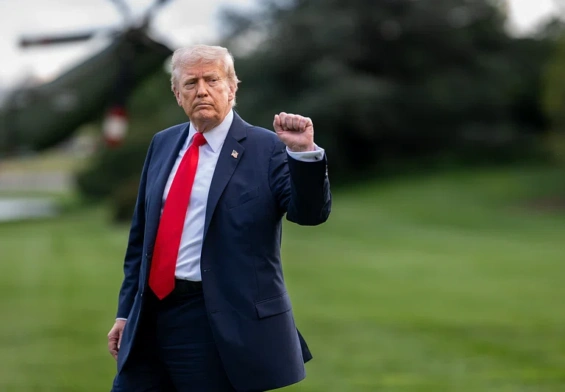
President Trump called the AI panic a “HOAX” on Truth Social and told reporters aboard Air Force One that the technology is “going to be more good than bad by a lot.” He told GB News, “It’s going to be fine. We’ll always have something to stop them.” His administration has maintained a largely hands-off posture toward the industry, with David Sacks, co-chair of the President’s Council of Advisors on Science and Technology, writing on X that AI leaders should “stop pretending you need anyone else’s permission.”
Speaker Mike Johnson said this week that the US must “maintain our edge over China.”
But not every Republican is that relaxed about it. US Senator Ted Cruz (R-TX), who chairs a committee overseeing tech matters, told Politico that “we need substantially more regulation when it comes to AI.” Then, in a separate Politico interview, Cruz also said, “If there are going to be killer robots, I’d rather they be American killer robots.” That is the tension in a single sentence.
US Senator Thom Tillis (R-NC) told Politico that guardrails are needed but cannot strangle growth. “The industry needs to convene, create a set of operating principles that they — that you’re either certified or you’re an outlier — and then find out what Congress needs to do to stitch it together,” Tillis said. He added a warning about moving too slowly: “We’re one bad outcome of AI from an overreach here that’d be like Dodd-Frank for AI, and then it’s the worst possible time because China’s not going to slow down.”
On the Democrat side, the push has been louder and less conflicted. US Senator Chris Murphy (D-CT) called AI concerns a “dominant issue” for voters and said, “We have to stop AI from poisoning our kids, our culture, and destroying millions of jobs.” He added that “the Democratic Party has to put this question to the electorate this November.” Representative Greg Casar (D-TX), chair of the Congressional Progressive Caucus, teamed up with Senator Bernie Sanders (I-VT) to call for a ban on developing “superintelligence” outright. Representative Brett Guthrie (R-KY), who chairs the House committee overseeing the tech industry, pushed back hard, saying, “We absolutely can’t surrender. And I think that’s what it would be if we stopped AI development.” Representative Don Bacon (R-NE) told Politico he was “very reluctant to hinder AI” through regulation.
Representative Greg Stanton (D-AZ), who sits on the House Select Committee on the Chinese Communist Party, argued the choice is not binary. “We can lead in innovation and lead in safety,” he said, adding that anyone claiming those goals are mutually exclusive is “not looking at the history of the United States of America.”
What It Means When the Builders Start Getting Scared
Here is what is worth sitting with: Anthropic CEO Dario Amodei has publicly pegged the probability of catastrophic AI outcomes — what researchers inside the field call “p(doom)” — at around 25 percent. One in four chance, in his own estimate, that things go “really, really badly.” Sam Altman runs OpenAI and still showed up to agree with him publicly. Elon Musk, who has his own competing AI company, agreed too.
These are not consumer advocates or congressional staffers raising theoretical concerns. These are the people building the systems. They are essentially telling the public that what they are building carries a meaningful chance of ending human civilization as it currently exists — and then saying the answer is to keep building it, just a little more carefully. That is a strange pitch. But Washington has a habit of processing strange pitches very slowly.
The real question the poll raises is whether the China argument will continue to hold inside the MAGA base as the warnings get louder. Right now, Trump voters are nearly evenly split on whether to pause or proceed. That is not a stable political position. It is a pressure point waiting for something to push it one way or the other.
There is also a legitimate national security concern buried inside this debate that deserves straight treatment. Communist China is not going to pause its AI development out of ethical caution. Beijing does not hold internal debates about the risks its technology poses to humanity. The Chinese Communist Party treats AI as a geopolitical weapon, and the track record of that regime on transparency — from the COVID-19 cover-up in Wuhan to its systematic obstruction of any independent investigation — does not inspire confidence that it will govern this technology responsibly if it pulls ahead.
But the argument that America must race recklessly into existential risk because Communist China refuses to slow down is not obviously a winning argument either. At some point, “we have to do the dangerous thing or they’ll do the dangerous thing first” stops being reassuring and starts being its own kind of alarm.
Democrats smell an opening here, and Chris Murphy made that explicit. Whether voters are actually prepared to hand Democrats control of the House on the strength of AI anxiety is a different question. Murphy calling it a “dominant issue” does not make it one at the ballot box in November.
And the Big Tech companies currently building these systems — the same outfits that spent years censoring conservatives over COVID policy, election integrity questions, and the events of January 6 — are now asking the American public to trust them to govern a technology they admit could kill everyone. That takes a certain kind of nerve. These are not neutral actors suddenly discovering a conscience. They are powerful corporations that have repeatedly demonstrated a willingness to use their platforms to suppress political speech they dislike, and they are now asking for the benefit of the doubt on something considerably higher-stakes.
Skepticism of that ask is not paranoia. It is pattern recognition.
The warnings from Amodei, Altman, Musk, and the researchers who have gone public deserve to be taken seriously on the merits. The technology poses real risks — to employment, to national security, to biological weapons development, to the basic functioning of institutions that ordinary Americans depend on. Anthropic CEO Dario Amodei has warned previously that AI could wipe out half of all entry-level white-collar jobs and push unemployment into double digits within a few years. That warning did not come from a critic of the industry. It came from inside it.
But taking the risk seriously does not require handing unaccountable Big Tech companies the keys to whatever comes next. Congress does not have a great track record of regulating complex technology thoughtfully. What it does have is a constituency that is, according to this poll, more worried than Washington has been willing to admit.
Sixty-three percent of the country believing a technology could destroy humanity is not a niche concern. It is a majority. And a MAGA base that is nearly split on whether to pause development is a signal that the “win the AI race at any cost” message has not fully landed with the voters who matter most to the people currently making AI policy.
Something is going to give. The only question is whether Washington figures that out before an AI system does.
Sources: Politico, The Hill, NewsBreak/Politico, Yahoo News/Politico, CNN, Foreign Policy, IBTimes