Joe Biden gave Kamala Harris the vice presidency, handed her the 2024 nomination, and got cut loose from her presidential history lesson without so much as a footnote.
She stood at a major national conference and rattled off her favorite presidents — and the man she served for four years didn’t make the list.
And the names she chose to praise instead tell you exactly where she thinks she’s going next.
The Snub Heard Round Nashville
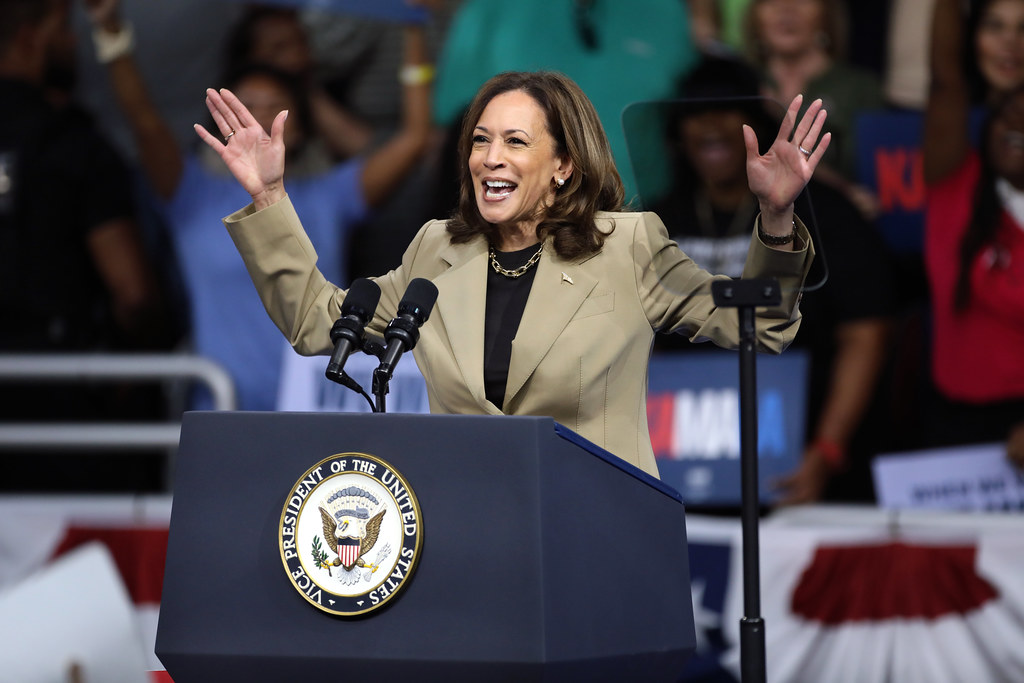
Former Vice President Kamala Harris failed to mention her ex-boss when asked who she thought were America’s most effective presidents, during an appearance at the National Urban League Conference in Nashville, Tennessee, where National Urban League President Marc Morial put the question to her directly.
Morial asked, “In your view, rank the top three most effective presidents in American history,” and Harris replied, “Oh Marc, don’t make me do that,” before proceeding to name Franklin Delano Roosevelt, John F Kennedy, and Lyndon B Johnson.
She named Roosevelt for “investing in people during dire times,” and then listed Kennedy and Johnson for their individual work.
Harris noted that FDR “talked about the expansion of the Supreme Court, and then he got ferocious blowback for that,” before citing Social Security and adding, “When I think about what he did in terms of investing in the people during dire times and talking about the role and responsibility of government, that it should not just be about the benevolence of community organizations or just interpersonal relationships, the government has a role.”
That’s a telling choice of praise. FDR’s court-packing scheme — the very thing Harris admires him for attempting — was rejected by the US Senate by a vote of 70 to 20 in 1937. Even many Democrats opposed it as an attack on judicial independence and separation of powers. Harris apparently sees that as a model worth revisiting rather than a cautionary tale.
Harris continued, “I credit Kennedy, of course, in terms of what he laid the groundwork for, and then Johnson followed up on,” before concluding with former President Barack Obama for “what he did with the Affordable Care Act and many things,” adding, “If we had one issue that’s been ailing America for generations, which is a healthcare system that has failed anyone other than the rich.”
The Affordable Care Act — which Harris held up as one of the great achievements of American governance — drove up premiums for millions of working families, narrowed provider networks, and handed the federal government sweeping control over one-sixth of the US economy. Praising it as a solution to a healthcare system that “failed anyone other than the rich” is the kind of line that sounds good at a progressive conference and falls apart the moment an ordinary family opens their insurance bill.
Biden’s name did not come up at any point in her response, despite her having served as his vice president for a full term.
A Feud That Never Really Ended
The omission wasn’t accidental. The two have feuded openly since her loss, according to the New York Post.
After she lost the Electoral College and the popular vote to President Donald Trump, Harris faulted Biden’s White House in her book 107 Days, writing that its communications team left her to absorb blame over the border.
Harris spent considerable ink in that book making the case that Biden’s team actively worked against her. “When polls indicated that I was getting more popular, the people around him didn’t like the contrast that was emerging,” Harris wrote. “Their thinking was zero-sum: If she’s shining, he’s dimmed. None of them grasped that if I did well, he did well.”
And yet she ran his policies, defended his record, and spent four years as his number two. Now she’s rewriting the credits. The woman who couldn’t separate herself from Biden fast enough during the 2024 campaign — and still lost by a comfortable margin — wants credit for nothing that went wrong and recognition for everything she claims went right.
Harris became the Democrat nominee in the summer of 2024 after Biden imploded during a debate against Donald Trump. Biden dropped his reelection bid three weeks later and threw his support behind Harris, who ran an abbreviated campaign using some of Biden’s campaign staffers. She lost both the electoral vote count and the popular vote to Trump.
What She’s Actually Selling
The presidential history lesson wasn’t really about history. Harris embraced a series of progressive policy proposals she did not campaign on in 2024, including expanding the Supreme Court and abolishing the Electoral College, at the very same Nashville appearance.
She called for expanding the court to 13 justices and revisiting statehood for Puerto Rico and Washington, DC.
Let’s be clear about what those proposals actually are. Packing the Supreme Court with four additional justices would turn it into a Democrat rubber stamp for a generation. Abolishing the Electoral College would permanently tilt every future presidential election toward the most densely populated urban centers, locking out the rest of the country. Adding Puerto Rico and Washington, DC as states would hand Democrats four guaranteed Senate seats and reshape the electoral map in ways that would take decades to undo. These aren’t policy reforms. They’re a blueprint for permanent one-party dominance dressed up as constitutional housekeeping.
Harris praised FDR for trying to pack the court and got ferocious blowback. Now she wants to try it again herself. The irony apparently escaped her.
Despite the new policy positions, Harris said she has “not made a decision” about 2028 and is “fully, sincerely, focused on these midterms.” That’s the kind of answer that fools nobody paying attention. She flew to Nashville, unveiled a sweeping platform, and praised every Democratic president who expanded the size and reach of the federal government. That’s a campaign rollout, not a civic lesson.
But here’s the problem with her strategy. Former Vice President Kamala Harris, who lost to President Trump in 2024, was backed by just 5 percent of likely Democratic primary voters in New Hampshire, according to a recent University of New Hampshire survey. Her support dropped from 11 percent in an earlier poll to 5 percent.
That poll placed Harris well behind Representative Alexandria Ocasio-Cortez and former Transportation Secretary Pete Buttigieg in New Hampshire, a state that has historically played an outsized role in shaping presidential nominations.
She’s chasing a base that’s already moving on to newer faces. The same progressive voters she’s now courting with court-packing proposals and Electoral College abolition are lining up behind a 36-year-old congresswoman from the Bronx. Harris lost to Trump. Then she lost the narrative to Biden’s team. Now she’s losing the left to AOC.
The presidential rankings she offered in Nashville were less a history lesson than a loyalty test — to the idea that government growth, federal expansion, and centralized control represent the highest expression of American leadership. FDR, JFK, LBJ, Obama. Every name on her list is a president who made the federal government larger, more expensive, and more involved in the daily lives of ordinary Americans.
LBJ’s Great Society alone, which Harris implicitly celebrated through her praise of Johnson, cost the country more than $22 trillion in current dollars according to the Heritage Foundation, with the tab rising by roughly $1 trillion each year as more than 80 overlapping means-tested federal programs continue soaking up tax dollars.
And Obama’s Affordable Care Act — the achievement Harris held up as proof that government can solve the healthcare crisis — gave the American people narrower networks, higher premiums, and a federal bureaucracy embedded in their most personal medical decisions. That’s not a success story. That’s a cautionary tale about what happens when Washington decides it knows better than patients and their doctors.
Biden served four years. He signed trillions in spending. He presided over the worst inflation in 40 years, a border in freefall, and an exit from Afghanistan that left Americans stranded. And Kamala Harris, who stood beside him through all of it, couldn’t find room for his name on her list of greats.
That tells you everything about how she really views the Biden years — and everything about how she plans to run from them.
Sources: Breitbart, New York Post, The Hill, Mediaite, Daily Caller, Fox News, University of New Hampshire Survey Center, Heritage Foundation, Cornell Law Library, Federal Judicial Center