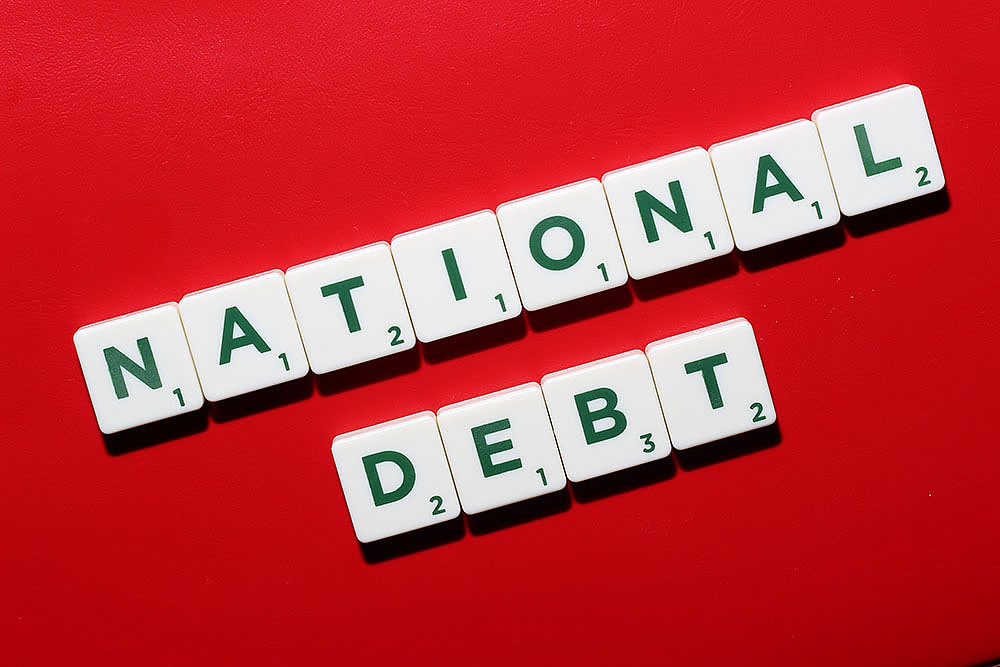
The national debt just crossed $40 trillion.
A comedian said what most Americans are already thinking but nobody in Washington will admit out loud.
And Tim Dillon torched the whole charade with a line that is going to be hard to forget.
The Number Nobody Wants to Say Out Loud
Comedian and podcaster Tim Dillon opened a recent episode of The Tim Dillon Show with a sarcastic standing ovation for the country’s newest financial milestone, asking his audience, “Can we get a round of applause for that?”
He wasn’t celebrating. He was doing what comedians do when the situation has gotten too absurd for straight commentary.
“It’s good because as it gets bigger and bigger, the chances of us paying it back really just completely collapse,” Dillon said. “Like, no one believes any of this is getting paid back.”
That’s the line right there. Not a policy paper. Not a congressional hearing. A comedian on a podcast putting into plain language what the bond markets, the Treasury Department, and every serious economist in the country already knows but refuses to say with that kind of directness.
The US national debt crossed $40 trillion, according to a Treasury Department daily financial update, reaching that level just five months after topping $39 trillion. Government spending is running more than $2 trillion over tax revenues every single year, and the trajectory shows no sign of reversing.
Dillon’s solution, offered sarcastically, cut right to the bone.
“So we need sort of a global war to reset the financial table, or a fake alien invasion, or something,” he said. “Hopefully, you guys are getting to work on that. Certainly seems like they are. No one believes we’re paying the $40 trillion back, we need a global war or a fake alien invasion, or potentially both.”
He then tied the alien invasion bit to a quote from Walmart’s Chief Financial Officer, who had explained the company’s falling share prices as the result of a “psychological shift” in consumer behavior driven by high gas prices.
Dillon ran with it.
“We’re going to have to use a few real aliens and like, because there’s probably an alien,” he continued. “He’s in Area 51 or whatever. He’s in, you know, he’s sitting there and they go up to him and they go, ‘Listen, we’re, we’re, hey, hey, we’re at $40 trillion worth of debt…Here’s the plan. We’re going to stage a fake thing and say you did it.’ And the alien’s going to go, ‘Ugh.'”
The bit lands because the underlying premise isn’t actually absurd. The fiscal situation is.
What Washington Won’t Say That a Comedian Will
There’s a reason a joke cuts through when a budget hearing doesn’t. The numbers have grown so large they’ve lost meaning to most people. A trillion dollars is not something a human brain processes intuitively. Forty of them is simply noise.
But Dillon’s framing strips away the abstraction. Nobody thinks this gets paid back. That’s not a fringe position or a doomer take — it’s the quiet consensus of anyone who has looked at the math for more than five minutes. The federal government spends dramatically more than it takes in every single year, interest payments on the existing debt are now one of the largest line items in the entire federal budget, and the political class in Washington has shown zero appetite for the kind of structural reform that would actually change the trajectory.
And both parties share the blame for getting here.
Republicans ran up the debt with defense spending and tax cuts that weren’t paired with corresponding reductions elsewhere. Democrats ran it up with entitlement expansions and social spending programs that were sold as temporary and became permanent. The COVID-19 era saw both parties agree to spending packages that added trillions to the national debt in a matter of months, with almost no debate about the long-term consequences.
The result is a country that has been borrowing against its future for decades, and the bill is now $40 trillion and growing by roughly $2 trillion every year.
Dillon’s joke about a fake alien invasion is funny because the actual alternatives are worse. A genuine reckoning with the debt would require either massive tax increases that would crush the economy, or cuts to entitlement programs so large that they would be politically impossible to pass, or both. So the political class does what it has always done: borrows more, argues about smaller things, and kicks the problem to the next generation.
Why This Matters Beyond the Punchline
The Walmart angle Dillon pulled into the bit is worth sitting with for a moment. Walmart’s Chief Financial Officer attributed the company’s falling share prices to a “psychological shift” among consumers reacting to high gas prices. That’s a corporate euphemism for something simpler: people are running out of money.
Gas prices, grocery prices, housing costs, interest rates on car loans and mortgages — all of these are downstream of a federal government that has spent recklessly for decades and is now watching the consequences ripple out into the real economy. When the government borrows this much, it competes with private borrowers for available capital, which pushes up interest rates, which raises the cost of every mortgage, every car loan, every small business credit line in the country.
That’s not a conspiracy theory. That’s basic economics. And it’s why the $40 trillion number isn’t just a punchline — it’s a weight that working Americans carry every time they fill up the tank or look at what they’re paying for a house.
The investors who lend the government money are also starting to get nervous. When lenders get nervous, they demand higher interest rates to compensate for the risk. Higher rates on government debt mean the federal government spends more on interest payments, which means it has to borrow even more to cover the gap, which makes lenders more nervous, which pushes rates higher still. It’s a cycle that ends badly.
Dillon’s comedy works because he’s describing a situation that has no clean resolution. There’s no version of this story where the $40 trillion quietly disappears. There’s no responsible adult coming to fix it. The people who were supposed to be the responsible adults in the room are the ones who ran the number up to $40 trillion in the first place.
And the best any of them can offer is a press release about fiscal responsibility followed by another vote to raise the debt ceiling.
The fake alien invasion joke is funny. The actual fiscal situation is not. But sometimes it takes a comedian to say the thing that the whole room already knows and nobody wants to admit.
Because at $40 trillion, the math doesn’t care who’s in charge. It just keeps compounding.
Source: Mediaite, “Tim Dillon Marvels At US Debt Hitting $40 Trillion: ‘No One Believes Any Of This Is Getting Paid Back'”