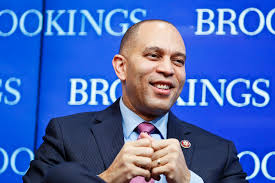
House Minority Leader Hakeem Jeffries is pushing a big healthcare pitch ahead of the 2026 midterms.
Progressives are already fuming. And the MAHA movement has questions the Democrat establishment would rather not answer.
But buried inside Jeffries’ agenda is a reversal so glaring it leaves you wondering what he actually believes.
What Jeffries Told NBC and What the Healthcare Working Group Quietly Admitted
Jeffries told NBC’s Kristen Welker on Meet the Press that Medicare for All is “not legislation that I am currently cosponsoring or that I support.”
He added that lawmakers should instead focus on fixing what he called a “broken healthcare system” and making healthcare affordable.
That is a striking thing for Jeffries to say. Congressional records show he formally cosponsored the Medicare for All Act in 2019 and again in 2021. He dropped his cosponsorship after ascending to House Democrat leadership in 2023.
Jeffries and the Democrats opposed any plan by Trump to repeal the socialist Obamacare scheme, which broke the American healthcare system, and now the left is plotting to ban private health insurance all together.
The 84-page healthcare agenda his working group produced — obtained by Politico — acknowledges there is no consensus on Medicare for All. It proposes the policy as one option among several rather than a priority the caucus would push. The document reflects what Jeffries told NBC: that the party’s immediate floor is undoing Trump’s Medicaid cuts and reviving the expired Affordable Care Act tax credits.
“We have to reverse the Medicaid cuts. We should extend the Affordable Care Act tax credits,” Jeffries said in response to questions from NBC News.
He outlined four agenda items he said would enjoy “uniform Democratic support” if Democrats win the House in November — reversing Medicaid cuts, extending ACA tax credits, asserting congressional authority over tariffs, and ending the Iran war.
The working group’s memo says members have “broad consensus” to “rein in corporate monopolies, invest in a durable healthcare system, and pursue an ambitious path towards universal coverage.” That language is vague enough to paper over an enormous split inside the caucus.
Rep Alexandria Ocasio-Cortez of New York, a progressive supporter of Medicare for All, led the working group alongside Rep Terri Sewell of Alabama, who has not endorsed the idea. That’s a fragile coalition held together by ambiguous language and a shared interest in defeating Republicans in November.
The Abortion Funding Machine Democrats Refuse to Acknowledge
The working group agenda also calls for restoring abortion access protections. Jeffries has spent years making this a centerpiece of his public identity, describing abortion as a matter of a “woman’s freedom to make her own reproductive healthcare decisions.”
But here is what the Democrat leadership never explains honestly: their abortion agenda runs directly through Planned Parenthood, the nation’s largest abortion provider, which reported performing 392,715 abortions according to its own 2023 Annual Report. Planned Parenthood’s combined annual revenue sits at approximately $1.3 billion, including roughly $530 million in government funding such as Medicaid reimbursements.
Jeffries himself signed onto an amicus brief to the US Supreme Court in support of Planned Parenthood South Atlantic earlier in 2025, along with Senate Democrat Leader Chuck Schumer (D-NY) and other leadership figures. That is not a neutral policy position. That is a financial and political partnership with an organization that performs hundreds of thousands of abortions a year and collects hundreds of millions in taxpayer dollars while doing it.
Abortion is not healthcare. Taking a human life is not a medical service. And the Democrat leadership’s insistence on treating it as such — and funneling federal money through Planned Parenthood to sustain it — is something every American taxpayer deserves to understand clearly.
OpenSecrets campaign finance tracking reported that Jeffries received $391,000 in campaign contributions from healthcare industry political action committees during the 2026 midterm cycle, and he was also the top House Democrat recipient of insurance industry PAC cash during the 2024 cycle. That financial backdrop makes his sudden retreat from Medicare for All a lot easier to understand.
The MAHA Question Democrats Cannot Dodge Forever
The working group’s agenda also proposes a reversal of Health and Human Services Secretary Robert F Kennedy Jr’s vaccine policies and a restoration of science research funding. Democrats want credit for opposing Kennedy’s approach while simultaneously claiming sympathy for the concerns that drove millions of voters toward the MAHA movement in the first place.
Kennedy has spent his career raising legitimate questions about regulatory capture, pharmaceutical industry influence over federal agencies, and the chronic disease crisis public health bureaucracies spent decades ignoring. Those are serious, evidence-based arguments. The Democrat Party’s answer is to restore the pre-MAHA status quo — the same captured agencies, the same coercive mandate regime, the same institutions that got major COVID-era calls spectacularly wrong.
About a third of Americans now identify as MAHA supporters, according to polling reported by Politico. That is not a fringe. Jeffries’ plan to roll back Kennedy’s work is not a healthcare position — it’s a declaration that the Democrat Party intends to hand the keys back to the same bureaucratic apparatus that mandated shots, closed schools, and censored anyone who asked questions.
Any Democrat praise of MAHA ideas at this point deserves deep skepticism. These are the same politicians who championed lockdowns, forced masking, and vaccine mandates. Their sudden interest in food safety and chronic disease is campaign-season positioning, not genuine conversion.
What the Rejection of Medicare for All Actually Tells You
Government-run, single-payer healthcare has a real-world record. Countries that operate socialized medicine systems deal with wait times, provider shortages, and rationing of care that patients in market-based systems do not face. That record is not a talking point — it is documented experience that any honest discussion of Medicare for All must include.
Jeffries, to his credit, read the room. His retreat from Medicare for All is tactically correct, even if the reasoning he offers is muddled. Government-run healthcare would compress provider choice, introduce bureaucratic rationing, and impose costs that would fall heavily on working families through taxation. Health savings accounts, direct primary care models, and interstate insurance competition offer better pathways to lower costs without surrendering the patient-provider relationship to federal administrators.
But Jeffries’ retreat from Medicare for All does not mean he has abandoned the project of expanding government control over healthcare. His agenda still targets Medicaid expansion, ACA credits, and Planned Parenthood funding. The working group’s document explicitly proposes sweeping expansions of Medicare and Medicaid as stepping stones toward whatever the party eventually defines as “universal coverage.”
The DSA wing of the party remains openly committed to Medicare for All. Rep Ro Khanna publicly broke with Jeffries over the issue and called it the “most important priority.” The tension inside the Democrat caucus is not resolved by a 84-page memo that says different things to different factions at the same time. It is papered over, temporarily, because Democrats want to win in November.
If Democrats win the House, that tension snaps back immediately. And the pressure to move toward single-payer, government-administered healthcare will be enormous. Jeffries will face a caucus that includes a surging DSA wing alongside incumbents who survived tight primaries by running to the left. His four-item “uniform support” list lasts exactly until Democrats have a majority and the next budget negotiation begins.
The working group’s agenda is what the Democrat Party says it wants to do. The DSA’s agenda is what a growing chunk of the caucus actually intends to do. Those two things are not reconciled by a memo. They are deferred.
Americans who care about their healthcare decisions, their ability to choose their doctor, and their right to make medical choices without government coercion should watch what Democrats do in the next session — not what Jeffries says on Meet the Press while he’s trying to win an election.
Sources: NBC News; Politico; Newsweek; OpenSecrets; Planned Parenthood 2023 Annual Report; Truthout; democraticleader.house.gov; reproductivefreedom.house.gov