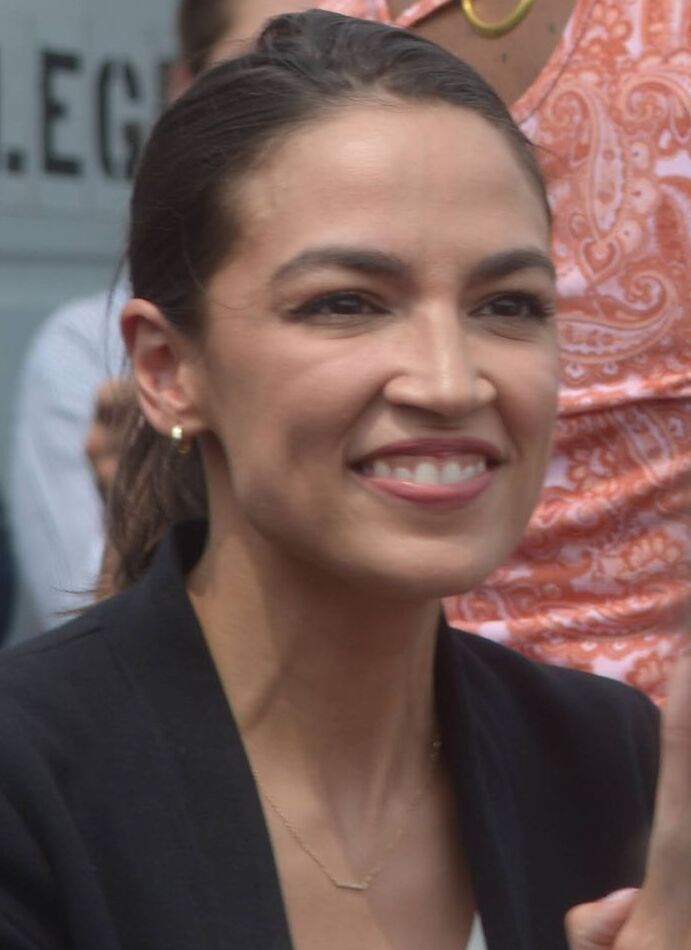
Alexandria Ocasio-Cortez wants to run for President.
She knows she needs to broaden her support beyond the socialist base.
And AOC doesn’t want anyone to notice this scandal from her past.
What AOC Actually Said
Alexandria Ocasio-Cortez built her political career championing lockdowns, mask mandates, and vaccine mandates during the COVID-19 pandemic.
Now she wants credit for agreeing with the Make America Healthy Again movement.
And the congresswoman’s sudden embrace of MAHA talking points is raising eyebrows among the millions of Americans who remember exactly where she stood when it mattered most.
During a recent appearance on the leftist Majority Report podcast, Representative Alexandria Ocasio-Cortez (D-NY) told host Sam Seder that she actively engages with MAHA supporters and does not see the movement as a partisan one.
“I actually meet with MAHA activists, I work with MAHA advocates because a lot of them really don’t believe that their fight is partisan, and it’s not, in many ways,” Ocasio-Cortez said.
She went further, pointing to what she described as systemic rot across both political parties when it comes to food and corporate accountability.
“We do have extraordinary corruption in our agricultural system, in our big corporate system as well,” Ocasio-Cortez said. “And this is an area where both parties and our entire political system has been compromised.”
She tied the movement’s growing popularity to the cost and distrust of the American healthcare system, saying, “It’s because there’s a ton of anxiety around our healthcare system.”
Ocasio-Cortez also brought in her own upbringing to make the point feel personal. “I grew up in a household that was very much shaped by these dynamics,” she said, adding that her Catholic faith informed her family’s skepticism of institutions.
She went on to argue that distrust runs even deeper along racial lines. “If you add the racial component too — I’m Puerto Rican, the United States sterilized women for decades,” she said. “And so you have COVID, you have vaccines and obviously in the Black community, same thing.”
“That is a perfect storm of a lack of trust in institutions that is oftentimes very valid and very legitimate,” she continued.
She also pointed to PFAS contamination — the class of industrial chemicals known as “forever chemicals” — as an area where her work in Congress overlapped with MAHA concerns, noting her early involvement in congressional investigations on PFAS dumping.
“I see how all of these issues, that have been at their surface level expressed as right wing, are actually very much just the anxieties that we have as working people not being able to afford healthcare,” Ocasio-Cortez said.
The Record She Wants Voters to Forget
The MAHA movement was built on a core set of principles: medical freedom, parental rights in healthcare decisions, opposition to government overreach in medicine, and a rejection of the top-down public health apparatus that dominated the COVID era. Those are not principles Alexandria Ocasio-Cortez championed when they were unpopular.
According to the Washington Times, Ocasio-Cortez “firmly supports mask and vaccine mandates” — a position well documented during the height of the pandemic. New York, whose strict masking and vaccine mandates for businesses she publicly supported, became one of the most locked-down states in the country.
And when workers across New York City lost their jobs for refusing COVID vaccine mandates, Ocasio-Cortez declined to support their reinstatement. According to reporting by Firsthand Media, she declined to voice support for reinstating New Yorkers who were fired under COVID-19 vaccine mandates at a town hall in the Bronx, and her response implied continued support for mandates in certain sectors.
That record does not square with the MAHA movement’s foundational commitment to bodily autonomy and informed consent. The people who built this movement did so while figures like Ocasio-Cortez were calling for exactly the kind of government coercion MAHA stands against.
But now that MAHA is polling at 41 percent support among American adults, according to a KFF survey, the political calculation has apparently shifted.
Why This Sudden Embrace Should Raise Red Flags
MAHA did not become popular because Alexandria Ocasio-Cortez decided to pay attention to it. The movement grew because Health and Human Services Secretary Robert F Kennedy Jr and President Donald Trump put real political capital behind questions that the medical establishment had long refused to take seriously — questions about ultra-processed food, chemical contamination, the revolving door between federal agencies and corporate America, and the genuine costs of a healthcare system that profits from keeping people sick.
Kennedy has spent decades fighting corrupt corporations and government agencies on exactly these issues. He built the WaterKeeper Alliance, sued ExxonMobil, and took on General Electric over toxic runoff long before MAHA was a political movement. His positions on food safety, PFAS, corporate capture of regulatory agencies, and the need for transparency in medicine represent a coherent, evidence-grounded critique of the status quo.
Ocasio-Cortez, by contrast, spent the pandemic years demanding compliance with the very institutional authority MAHA challenges. She cheered on the agencies whose credibility the movement exists to question.
The KFF poll that found 41 percent of US adults identifying with MAHA also found that 75 percent of Americans believe there is not enough regulation of chemical additives in food, and 64 percent believe pesticide regulation is insufficient. Those numbers cut across party lines. That kind of broad public sentiment is exactly what makes MAHA attractive to a politician eyeing a national profile.
Ocasio-Cortez is widely viewed as a potential Democrat presidential contender. She is also the face of the Democrat Party’s socialist wing — a faction that has never met a government mandate it didn’t like, a federal program it wouldn’t expand, or a private healthcare market it wouldn’t gladly replace with a government-run system. Medicare for All, which she has championed, would hand the federal government total control over healthcare delivery — the exact opposite of the patient choice and medical freedom MAHA advocates have been fighting for.
Genuine MAHA principles require trusting individuals over bureaucracies, parents over agencies, and markets over mandates. That is not a description of anything Alexandria Ocasio-Cortez has ever voted for.
The MAHA movement’s concerns about corporate corruption in agriculture and the food supply are real, and they deserve serious engagement from politicians of both parties. But jumping on a popular health movement while quietly maintaining support for the same government-controlled healthcare apparatus that created the anxiety she is now describing is not engagement. It is positioning.
Voters who lived through the lockdowns, the firings, the mandates, and the dismissal of anyone who raised legitimate questions about public health policy deserve better than a politician who opposed their medical freedom when it cost something and now wants to stand beside them when it polls at 41 percent.
Sources: Fox News; Washington Examiner; Where Is The Buzz; Firsthand Media; Washington Times; KFF Health Tracking Poll (May 2026); Gillespiereport.substack.com