
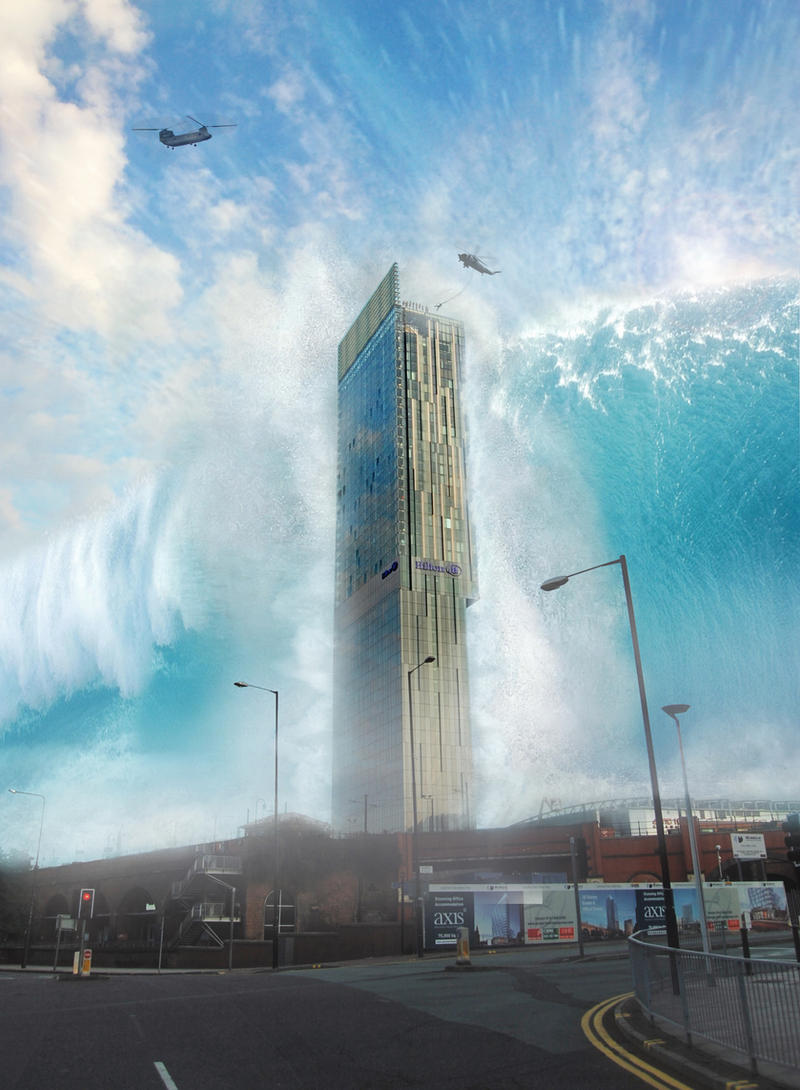
A massive wall of volcanic rock is creeping toward the Atlantic.
Now one doomsday prediction has the coastline where tens of millions of Americans live in its crosshairs.
And one volcano professor just admitted the single question he can’t answer.
A Wall of Rock Keeps Creeping Toward the Atlantic
Volcanologist Professor Bill McGuire has his eye on Cumbre Vieja, a volcano on the island of La Palma in Spain’s Canary Islands.
His worry isn’t the lava. It’s a massive slab of the mountain, which geologists call a flank, that keeps inching a little closer to the sea.
McGuire laid out his case in an article for BBC Science Focus. And he left himself very little wiggle room. “Based on extensive studies, I expect this part of the flank will eventually crash into the North Atlantic, launching a megatsunami in the process,” he wrote.
If that rock lets go all at once, it shoves an almost unimaginable volume of water westward. McGuire’s computer simulations put the worst case at waves as tall as 65 feet slamming the Eastern Seaboard within about nine hours.
Supporters of the theory point to giant boulders sitting where no boulder has any business sitting, along coastlines in the Bahamas. Geologists believe prehistoric Canary Island tsunamis hauled those rocks clear across the ocean.
That’s the scary part. Now comes the part most of the coverage skipped right past.
The Professor Can’t Even Pick the Century
McGuire himself admits nobody knows when, or even whether, the slope will give way. “I have no doubt this will be a cataclysmic event, but have no idea when it will happen,” he wrote, adding that “it could easily be centuries or even millennia down the line.”
Centuries. Or millennia.
That’s not a forecast anybody can plan a beach weekend around, let alone a coastline. But it didn’t stop the headlines from leading with the East Coast getting wiped out within hours.
And McGuire concedes his own field hasn’t settled the question either. He described “huge debate and discussion, sometimes quite heated, about the level of expected destruction,” especially over whether the truly devastating waves would ever reach North America.
That fight goes back a long way. Geophysicist Steven Ward and volcanologist Simon Day floated the Cumbre Vieja collapse scenario in a 2001 paper that modeled one gigantic slide. But later research hasn’t been kind to it. University of Liverpool researchers say follow-up studies show a Canary Islands collapse would likely reach the US with waves closer to an ordinary storm surge of a meter or two, and they note that a monster wave would have left telltale deposits across the Americas that nobody has ever found.
When Cumbre Vieja actually erupted in 2021, the lava ran for 85 days and wrecked homes and farmland across La Palma. Frightened people flooded volcanologists with messages about a coming megatsunami, and the US Geological Survey stepped in to explain why the scenario didn’t hold water. The flank stayed right where it was.
Hulu Already Sold America This Exact Apocalypse
If the whole thing sounds like a TV pitch, that’s because it already was one.
A megatsunami bringing about the end of the world is the premise of Paradise, the hit Hulu series from This Is Us creator Dan Fogelman. Sterling K Brown stars as Xavier Collins, a Secret Service agent living in a hidden underground city in Colorado after a supervolcano erupts beneath the Antarctic ice and sends a wall of water around the globe, flattening coastal cities and choking the sky with ash.
The show turned into a monster. Disney says audiences have logged nearly 12 billion minutes across its first two seasons, the first season grabbed four Emmy nominations including Outstanding Drama Series, and Hulu already ordered a third season.
But notice who gets saved in Fogelman’s version of the end times. A tech billionaire and a circle of Washington power players build themselves a luxury bunker, and everybody else on the coasts gets the wave.
Some of the entertainment press didn’t even pretend it was a volcano story, pitching the series as the aftermath of a climate catastrophe. Of course they did. In Hollywood, every disaster eventually turns into a sermon.
And Netflix went straight to the source, building its own disaster series around the La Palma theory. The Liverpool researchers grumbled that the show ignored the newer, calmer science entirely.
Doomsday Sells, and Somebody Always Wants to Buy
None of this makes McGuire a crank. He studies volcanoes for a living, and he was honest enough to say the timeline could stretch well past the lifetime of anybody reading this.
The trouble starts once a warning like his leaves the lab. The caveats fall off. The worst case climbs to the top of the page. And a “maybe in a thousand years” somehow becomes “within hours” by the time it lands on a phone screen.
Americans have sat through this movie before, and not on Hulu. In March 2020, a computer model out of Imperial College London projected roughly 2.2 million American deaths from COVID if the country did nothing at all. That worst-case number helped push officials on both sides of the Atlantic toward lockdowns, and governors went on to shutter schools, churches, and small businesses for months.
The climate crowd runs the same playbook. Feed a model the scariest assumptions, slap the result on the front page, then demand new taxes, new mandates, and new agencies to save everybody from a disaster that keeps getting pushed down the road.
Nobody in Washington has tried to cash in on Cumbre Vieja yet. But give it time. A slow-motion catastrophe with no deadline is a bureaucrat’s dream, because it never shows up and the funding never runs out.
Maybe that’s too cynical. Then again, the last few years haven’t exactly rewarded anybody for trusting the folks who run the models.
The coast has real hazards worth a hard look, from hurricanes to aging seawalls to emergency plans that exist mostly on paper. Those deserve attention long before a mountainside that may not budge in anyone’s lifetime.
And families in Florida, the Carolinas, and New Jersey don’t need to start digging a bunker in the backyard.
In Paradise, the end of the world arrives right on cue, and the well-connected few already have their bunker keys. Out in the real Atlantic, the professor sounding the alarm can’t even tell anybody which century to circle on the calendar.
Sources: New York Post; BBC Science Focus; University of Liverpool; Moody’s RMS; Soap Central; Monmouth University’s The Outlook; JoBlo; Pajiba; TV Guide; Den of Geek; tbreak (via Deadline); Metabunk

