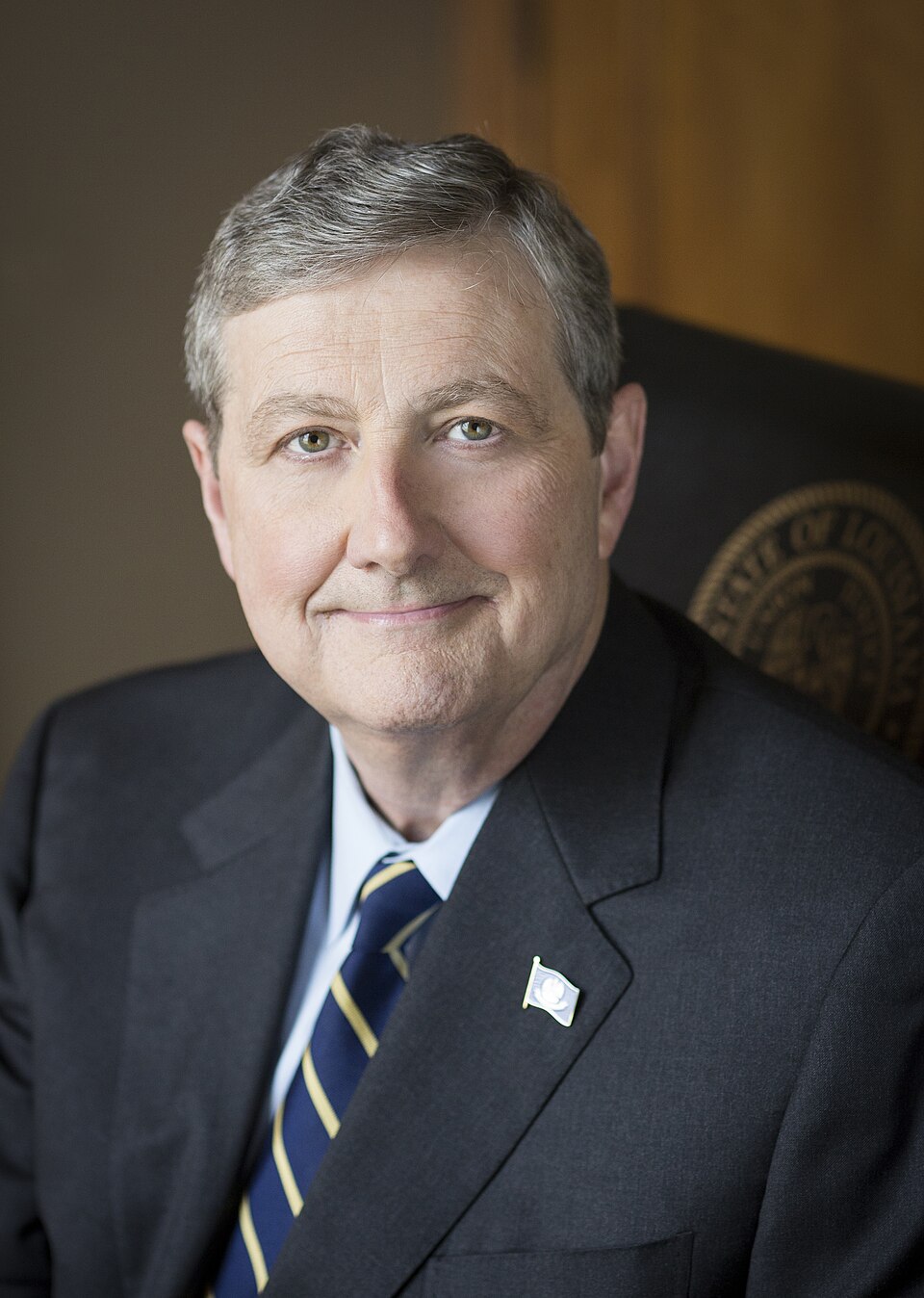
A reliably pro-Trump senator just broke ranks in a way nobody expected.
He did it live, on national television, and made clear he’d take the mockery if it came.
And US Senator John Kennedy took aim at the Trump White House over something that has Republicans and Democrats alike asking who approved this.
What Kennedy Said on Face the Nation
US Senator John Kennedy (R-LA) went on CBS’ Face the Nation recently and told host Margaret Brennan something that doesn’t fit neatly into any partisan script.
“I don’t think any public official, including President Trump, or Kristi Noem, or John Kennedy, should spend public money on private ads for themselves,” Kennedy told Brennan.
He kept going.
“Now, the White House sees it differently. But I think there oughta be a rule — well, there probably is a rule — you can’t spend public money to promote yourself.”
Kennedy didn’t stop at the ad controversy. He also said he thinks no politician should have a building named after him while he’s still alive — a jab at the Trump name appearing on the Kennedy Center — and he acknowledged the political risk of saying any of it out loud.
“I may end up with a sombrero on my head,” Kennedy said, referencing Trump’s habit of posting AI-generated videos that mock his critics, including past posts that put digital sombreros on House Minority Leader Hakeem Jeffries (D-NY) and Senate Minority Leader Chuck Schumer (D-NY).
That’s the kind of thing most Republican senators quietly think and never say. Kennedy said it anyway.
What the Ads Actually Are
The Trump administration ran ads ahead of the midterms touting what it calls its biggest wins — “reigniting American manufacturing,” the “largest tax cuts in history,” and a clip of Trump declaring “America will never be a communist country,” all set to a chorus singing “love me” in the background.
UFC boss Dana White also makes an appearance in the ad, calling Trump “the toughest, most resilient person that I’ve ever met.”
And at the end, the screen displays a label that reads: paid for by the US Government.
The Associated Press reported the administration spent $443,000 on the ads. The White House pushed back, insisting these are “public service announcements” rather than political ads — a distinction that determines whether the spending complies with federal rules.
Appropriations law has long prohibited using federal funds for what the statute calls “a general propaganda effort designed to aid a political party or candidates.” Whether these ads cross that line is now a live question, and not just among Democrats.
Kennedy was not alone among Republicans raising an eyebrow. The ads drew scrutiny from both sides of the aisle, though Kennedy delivered his objection with the kind of direct clarity that made it impossible to spin as a misunderstanding.
Why This Moment Is Worth Watching
Kennedy is not an establishment Republican looking for reasons to poke at Trump. His record tracks closely with America First priorities, and he clearly knew going into the Face the Nation interview that his answer would land like a grenade in certain corners of the internet.
But his objection was narrow and principled, not a broad critique of the Trump agenda. He named himself in the same sentence as Trump and Kristi Noem — the former Homeland Security Secretary who faced a congressional oversight hearing over a separate $220 million taxpayer-funded ad campaign that featured her prominently.
That detail matters. Noem’s ad controversy was itself a flashpoint earlier this year. Kennedy applying the same standard to Trump that he presumably applied to Noem isn’t grandstanding — it’s consistency, and consistency is a rare commodity in Washington, DC.
The White House’s “public service announcement” defense may satisfy some. Governments do have legitimate reasons to communicate with the public about policy changes, agency programs, and national priorities. A line exists somewhere between informing citizens and spending their money to build a political brand ahead of an election, and reasonable people can disagree about exactly where that line falls.
Kennedy seems to think these ads crossed it. The administration disagrees. That’s a debate worth having, and Kennedy deserves credit for having it in public rather than complaining behind closed doors and saying nothing on camera.
The sombrero line is also worth taking seriously for what it reveals about the current political climate. When a senator who supports the president’s agenda has to pre-apologize for offering a mild institutional critique — by acknowledging he may end up the target of a mocking social media post — something about the state of internal Republican accountability deserves attention.
That dynamic cuts both ways. A president who punches back at critics hard enough that even allies brace for retaliation before speaking creates a certain kind of discipline within the party. Whether that discipline produces better governance or simply less honest feedback from the people closest to the president is a question the base might want to sit with.
Kennedy has always been something of an outlier in that respect — willing to say plainly what most colleagues prefer to say in muffled, deniable ways. He’s been that way for years, on issues from spending to Senate procedure to foreign policy.
And he didn’t hedge. He named names. He included himself. He acknowledged the political cost and said what he thought anyway.
Whether the Trump White House revisits the ad spending in response to the bipartisan pushback remains to be seen. But the fact that a loyal, pro-Trump senator from Louisiana — one who clearly understood the risk — felt the need to draw a line publicly suggests the concern isn’t going away just because the White House labels the spots educational and patriotic.
Taxpayers watching those ads during college football games recently might have their own views on what category they belong in.
Sources: Mediaite, “Pro-MAGA Senator Calls Out Trump for Spending Public Money on TV Ad: ‘I May End Up With A Sombrero On My Head, But…'” (Sept. 2026); CBS Face the Nation transcript; Associated Press; Raw Story; Newsweek; The Daily Beast