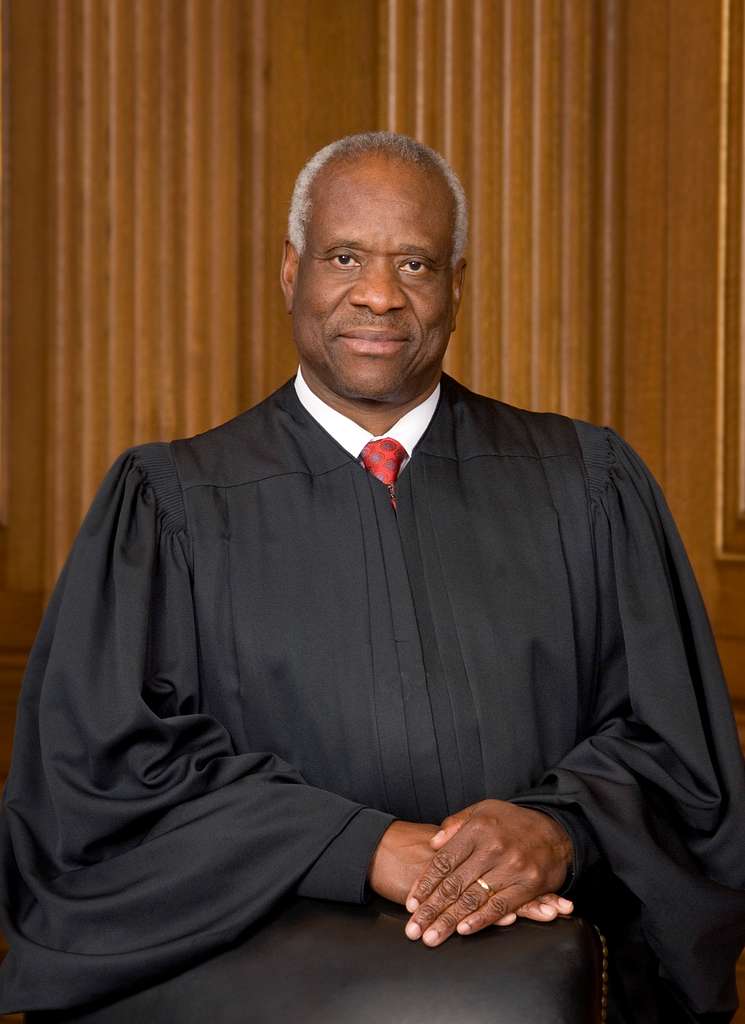
Justice Clarence Thomas has spent decades watching the American legal academy decide who gets a seat at the table.
He has a pretty clear idea of who doesn’t.
And what he told the Hoover Institution recently about Stanford Law School is something a lot of conservatives have known for years but rarely hear said out loud by a sitting Supreme Court Justice.
A Justice Who Has Never Set Foot in Stanford Law
Thomas sat down with Hoover Institution host Peter Robinson for a wide-ranging conversation about the life and legacy of economist Thomas Sowell, the Black conservative intellectual whose work helped shape Thomas’s own thinking from his days as a young lawyer all the way to the nation’s highest court.
At some point in the exchange, Robinson apparently pressed Thomas on the state of elite legal education. The Justice’s answer was blunt.
“You know, I have never been to Stanford Law School,” Thomas told Robinson.
Never. Not once. One of the most consequential originalists in the history of the Supreme Court, regarded by many conservatives as the finest jurist of his era, has never set foot in one of the country’s most prominent law schools. The reason, in Thomas’s own words, is not complicated.
“That’s the world we’re in, because there’s certain places that are just presumptively off limits,” Thomas said. “This is the way it works. And that’s true. I mean, I’ve been to Yale Law School, but that’s the way it works. And to say it isn’t, is to lie.”
He also noted that he and Sowell had simply gotten “no audience” at institutions like these. Not a hostile reception. Not a protest. Just nothing. A wall of institutional indifference dressed up as academic neutrality.
What Thomas Said About Sowell and the YouTube Generation
The conversation was framed around Sowell’s legacy, and Thomas made a point that deserves more attention than it’s likely to get from the mainstream press.
He said that if not for YouTube, Sowell’s ideas would be effectively lost to younger generations of students, because some views are simply too “unpalatable” for university gatekeepers to allow inside the building.
“And so what these kids are getting is all that stuff [that] is not there,” Thomas said, referring to what colleges actually teach. “It’s just on YouTube. It’s available to everybody, and they get to make up their own mind.”
There’s something both encouraging and quietly damning about that observation. Encouraging because young people can still find Sowell, Thomas, and other thinkers the academic establishment has tried to bury. Damning because the reason they have to go to YouTube in the first place is that the institutions built to educate them decided those ideas weren’t fit to enter the classroom.
Thomas also addressed something that has followed him his entire public life: the claim that his political views disqualify him from being considered authentically Black. He wasn’t having it.
“If they can prove you wrong, fine. But if they call you names or say you’re not black, I mean, how stupid is that? Look at me,” Thomas said, reportedly grabbing his own arm as he made the point.
That is not the response of a man who feels wounded by the criticism. That’s the response of a man who has heard it for forty years and has long since stopped pretending it deserves a more elaborate answer. When the only rebuttal to a man’s legal reasoning is to question whether he belongs to his own race, the argument has already been lost.
Stanford’s Response and What It Actually Tells You
Stanford did not stay quiet. A spokesperson issued a statement to Fox News Digital pushing back on the Justice’s characterization.
“We would be honored to host Justice Thomas at Stanford Law School,” the spokesperson said. “The Stanford Constitutional Law Center, directed by Professor Michael McConnell, former Judge on the US Court of Appeals for the Tenth Circuit, regularly hosts members of the judiciary on campus.”
The spokesperson added that students and faculty “would welcome the opportunity” to hear from Thomas and engage with his perspectives on the court, the Constitution, and the law.
Fine. But here’s what that statement doesn’t explain: why, in all the years Thomas has served on the Supreme Court, Stanford Law never apparently extended a formal invitation that led to an actual visit. A press statement issued in response to a news cycle is not the same thing as a standing welcome mat.
And Thomas, notably, did not say Stanford had explicitly banned him. He said certain places are “presumptively” off limits. That word choice matters. It describes a social and institutional atmosphere where conservative voices understand, without being told directly, that they are not wanted. The hostility doesn’t need to be written into a policy. It gets communicated through years of silence, through the composition of faculties, through the treatment of speakers who wander off the acceptable ideological path.
Anyone who watched what happened to Fifth Circuit Judge Kyle Duncan at Stanford Law School in 2023 knows exactly what Thomas is describing. Duncan was invited to speak, then shouted down by students while a DEI administrator lectured him from the stage. The school’s then-dean eventually apologized. But the incident made visible something that had been operating quietly for a long time.
The Bigger Picture Thomas Is Pointing To
This isn’t really about one justice and one law school. Thomas has been making a version of this argument for decades, and the Hoover Institution conversation, recorded in August 2026, gave him a platform to lay out the full arc of it.
The left-wing takeover of elite universities has produced a legal academy that trains future judges, clerks, and practitioners almost exclusively in one intellectual tradition. Students at these schools may graduate having never seriously engaged with originalism, natural law, color-blind constitutional principles, or the kind of free-market thinking that Thomas Sowell spent a lifetime developing and defending. They encounter those ideas, if at all, as positions to be refuted rather than arguments to be understood.
That’s not education. That’s indoctrination with better credentials.
Thomas has been a target of the sustained liberal smear campaign that began with the Anita Hill accusations during his 1991 confirmation and has never really stopped. The ethics attacks, the financial scrutiny, the racially charged insults from politicians who would never tolerate that language directed at any other public figure — all of it traces back to the same source. He is a Black conservative who rejects left-wing racial orthodoxy, and that has made him an object of institutional fury for his entire career.
But Thomas keeps showing up. He writes opinions. He gives interviews. He credits the thinkers who shaped him and tells younger generations to go find those ideas for themselves, even if they have to find them on YouTube because the universities won’t teach them.
That’s not a man who has been silenced. But his point stands: the silence itself is a policy, and the institutions enforcing it ought to own what they’re doing rather than issuing press statements when a Supreme Court Justice calls them out by name.
Stanford can say it would be honored to host Justice Thomas. The question is why it took a news cycle to say so.
Sources: Mediaite; Fox News Digital; The Hoover Institution, “The Sowell Legacy” (Peter Robinson interview with Justice Clarence Thomas, August 11, 2026); American Almanac; Conservative Institute