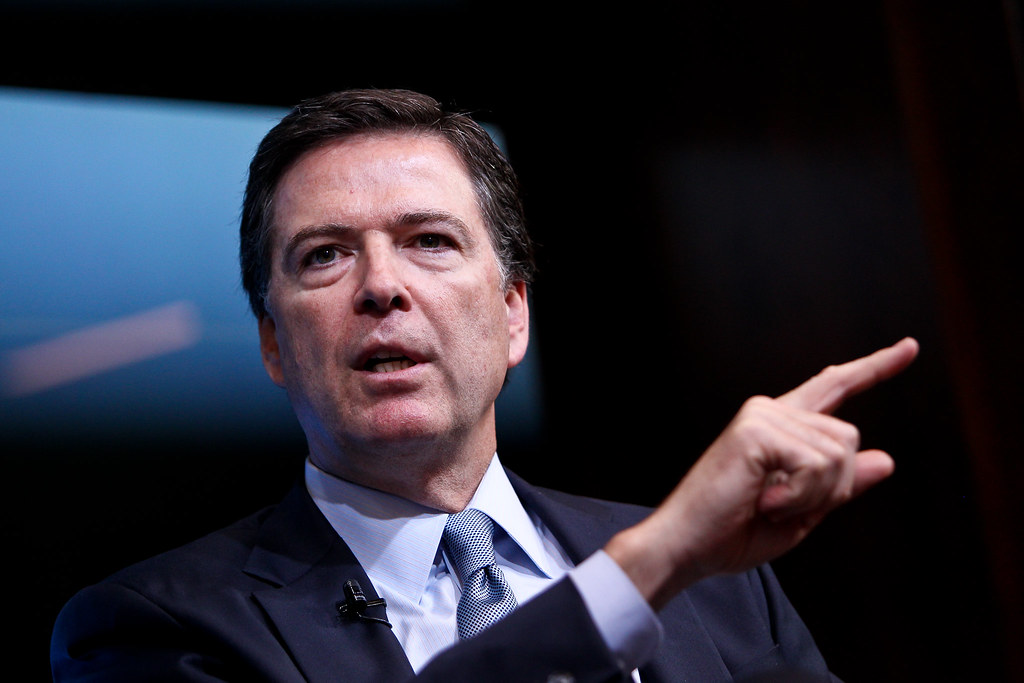
James Comey can’t seem to escape the long arm of the law.
The walls are closing in on the former FBI director — and now a brand-new grand jury subpoena just changed the equation entirely.
And Trump turned up the heat on Comey with one legal bombshell.
A Familiar Name Gets Subpoenaed Again
A federal grand jury issued a subpoena to former FBI Director James Comey’s longtime friend and adviser as part of a new investigation into Comey allegedly leaking classified information to the media.
Daniel Richman is a Columbia University law professor who also served with Comey in the Southern District of New York and at the FBI. He is not some peripheral figure in this story. He is the man who, by his own admission, served as Comey’s personal pipeline to the press.
Richman confirmed in 2017 that he leaked contents of one of Comey’s memos to The New York Times. Comey himself put it plainly under oath before Congress. “Didn’t do it myself, for a variety of reasons,” Comey said at the time. “But I asked him to because I thought that might prompt the appointment of a special counsel. And so I asked a close friend of mine to do it.”
That testimony has always been extraordinary. The sitting FBI director — after being fired — used a Columbia law professor as a cutout to feed information to a reporter at The New York Times, with the explicit goal of triggering a special counsel investigation into the President of the United States. And for years, nothing happened to either of them.
The issue was also investigated under President Donald Trump’s first term, but was cut off when former President Joe Biden entered office. The Biden DOJ shut it down. That’s the part the legacy media tends to skip past. The investigation existed. It had legs. And then a new administration arrived and made it go away.
In August 2019, the inspector general for the Department of Justice released a report on Comey that concluded he had leaked “sensitive” government records and violated DOJ rules. The OIG found the violations. The career bureaucrats declined to prosecute. And Comey walked.
What FBI Director Kash Patel’s Declassification Revealed
The story got considerably more complicated in August 2025, when FBI Director Kash Patel declassified a series of internal FBI memos that painted a detailed picture of how Comey allegedly used Richman as a secret media conduit.
Columbia University law professor Daniel Richman admitted to agents in interviews he routinely communicated on behalf of Comey, his longtime friend, with Times reporter Michael Schmidt. The goal, Richman told the FBI, was “to correct stories critical of Comey, the FBI and to shape future press coverage” outside of the bureau’s official press office, according to internal FBI memos that current Director Kash Patel delivered to Congress.
While Richman was known to have been publicly quoted in news stories as an advocate for Comey, he admitted to agents that he was given access by Comey to what turned out to be highly classified information up to the SCI level and sometimes provided information to reporters on an anonymous basis.
That is not a minor procedural violation. That is a sitting FBI director allegedly routing highly classified intelligence to a law professor with instructions to drip it to a newspaper reporter — anonymously — to shape public opinion and build pressure for a special counsel. And Comey personally arranged for Richman to be designated a Special Government Employee, giving him access to classified information despite operating outside the bureau’s formal chain of command.
The memos provided details on multiple classified leak investigations involving Comey, including: Arctic Haze, Tropic Vortex, Foggy Falls, Riding Hood, Sirens Lure, Echos Fate, and Genetic Christmas. Those are not random code names. Each one represents a separate classified leak inquiry. The breadth of that list tells you something about the scale of what investigators believe was happening inside the Comey FBI.
And yet for years, Comey faced no criminal consequences. The Biden DOJ made sure of that.
This Is the Third Front in the Comey Legal War
The new investigation is in addition to the one centered on Comey’s alleged threats against Trump. That case involves a now-deleted Instagram post that set off a firestorm.
Comey posted and then quickly deleted a picture of seashells arranged to spell out the numbers “86 47.” In the caption for the Instagram post, he wrote, “Cool shell formation on my beach walk.”
Trump has been direct about how he interprets that image. “’86’ is a mob term for ‘kill him.’ They say 86 him! ’86 47′ means ‘kill President Trump,'” Trump wrote in a social media post, before going on to assail Comey as a “Dirty Cop” who “knows this full well!”
Restaurant workers say the number simply means an order has been canceled. Comey’s own lawyers have argued the post is protected speech under the First Amendment. But the DOJ proceeded anyway, and Comey has been charged with two felony counts: one count of making a threat to kill or harm the president and a second count of transmitting that threat publicly. Both counts combined carry a maximum sentence of 10 years in prison.
Comey has denied wrongdoing on the seashell charges. “I’m still innocent, I’m still not afraid, and I still believe in the independent federal judiciary,” Comey said after the indictment was filed.
But denials have not stopped the legal machinery from grinding forward. And now, with the fresh subpoena targeting Richman in the classified leak probe, Comey faces a third distinct line of legal jeopardy running simultaneously.
There is also relevant history on Richman’s end. Richman, a law professor and former attorney for Comey, played a central role in the initial investigation into the leak in 2018. He also later filed a lawsuit arguing that prosecutors violated his Fourth Amendment rights by seizing material from his electronic devices during investigations in 2019 and 2020. A federal judge sided with Richman on that Fourth Amendment challenge, which complicated the government’s earlier effort to build a case. The new subpoena signals that prosecutors believe they can construct a fresh evidentiary record without relying on the disputed material.
What this amounts to is a systematic effort to revisit every instance where the Comey circle allegedly used classified government information as a political weapon against a sitting president — and then walked away clean because a sympathetic administration shut the investigations down.
The permanent Washington establishment spent years treating Comey as a martyr. He wrote a bestselling book. He gave speeches. He collected speaking fees. He posted beach photos on Instagram. The narrative his allies in the press built was that he was a noble public servant brought down by a vindictive president who couldn’t stand accountability.
But the OIG found he violated DOJ rules. The FBI’s own internal classified leak investigations — Arctic Haze and the rest — documented a pattern of using Richman as a back-channel to the press. Comey admitted under oath that he orchestrated the leak of his memo specifically to trigger a special counsel. And now a federal grand jury is looking at the question of whether classified information moved through that pipeline too.
The Biden administration’s decision to shut down the original leak probe in 2021 is worth dwelling on. Career bureaucrats and political appointees made a deliberate choice to end an investigation that the DOJ’s own inspector general had already found produced policy violations. That’s not justice. That’s protection. And it’s the kind of protection that the permanent Washington class extends to its own — the same class that spent years insisting that no one is above the law, right up until the moment the law came for one of their own.
Trump’s DOJ is now picking up where the first-term investigation left off. Whether the classified leak case produces charges remains to be seen. But the subpoena to Richman means the grand jury is active, the investigation is live, and Comey’s legal exposure just got wider.
The man who used a Columbia law professor to leak memos to The New York Times in order to engineer a special counsel investigation against a president is now facing that president’s Justice Department on three separate legal fronts. Whatever one thinks of the politics involved, the underlying facts of what Comey did — by his own sworn testimony — have never been in serious dispute. He admitted it. He just thought there would never be consequences.
That calculation may be changing.
Sources: Mediaite, “NEW: Trump DOJ Issues Fresh Subpoena In James Comey Investigation”; Fox News Digital, “New federal grand jury subpoena issued to former James Comey advisor in leak investigation”; American Greatness, “Report: Federal Grand Jury Issues Subpoena to Comey Pal Daniel Richman in Revived Leak Investigation”; Just the News, “Comey’s media mole admitted to FBI he shaped Russia narrative”; Washington Examiner, “DOJ weighs new classified leak charges against Comey”